
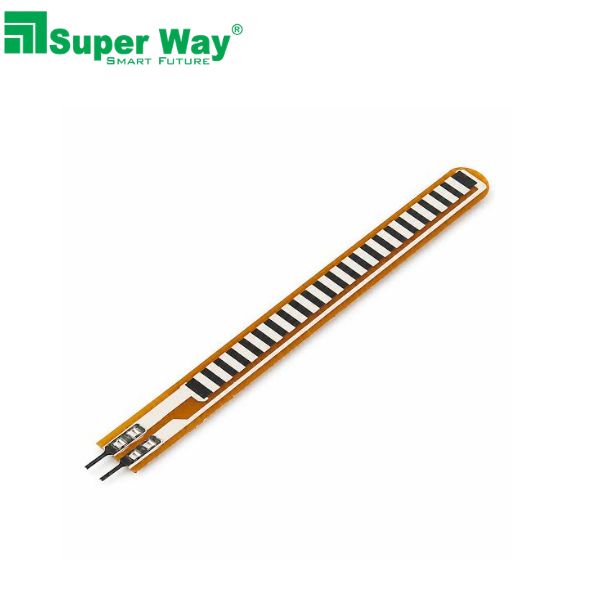
2.2 Inch Flex Sensor
- Brand: Superway
In stock
Wholesale Price
- 2.2-Inch Flexible Bend Sensor: The Superway 2.2 Inch Flex Sensor detects bending and flexing by changing its electrical resistance according to the degree of bend.
- Variable Resistance Output: Works as a flexible analog resistor, making it suitable for detecting relative bending, movement, and position in electronic projects.
- Compact Flexible Design: Its 2.2-inch sensing length is suitable for compact prototypes, wearable devices, robotic mechanisms, and motion-sensing applications.
- Wide Range of Applications: Ideal for Arduino, robotics, gesture recognition, smart gloves, VR/AR prototypes, wearable electronics, and DIY projects.
- Easy to Integrate: The Superway Flex Sensor can be used with suitable voltage divider circuits and microcontrollers for analog bend and movement detection.
2.2 Inch Flex Sensor – Flexible Bend and Resistive Sensor
The Superway 2.2 Inch Flex Sensor is a compact flexible resistive sensor designed to detect bending, flexing, and physical movement through changes in electrical resistance. Also known as a Flex Resistive Sensor, Bend Sensor, or Flexible Resistor, this electronic component is suitable for applications where the bending or movement of an object needs to be detected and converted into an electrical signal.
The Superway 2.2 Inch Flex Sensor works as a variable analog resistor. When the sensor remains flat or in its normal position, it provides a relatively lower resistance. When the flexible strip is bent, the resistance changes and generally increases according to the amount of bending. Superway 2.2 Inch Flex Sensor This resistance variation can be measured using an appropriate electronic circuit and interpreted as an indication of movement or bend.
Due to its compact size and flexible construction, the sensor is useful for electronic prototypes, Arduino projects, robotics, wearable devices, gesture recognition systems, and educational applications.Superway 2.2 Inch Flex Sensor It can also be used by makers, hobbyists, students, engineers, and product developers working on experimental motion-sensing projects.
How Does a Flex Sensor Work?
A flex sensor operates using the principle of variable electrical resistance. The sensor contains resistive material that responds to mechanical bending. When the sensor is straight or flat, the resistive path maintains its normal electrical characteristics. As the sensor bends, the internal structure changes, resulting in a change in resistance.
This resistance change can be measured by connecting the sensor to a suitable circuit. One common method is to use the flex sensor in a voltage divider circuit along with a fixed resistor. When the flex sensor bends, its resistance changes, causing the output voltage of the circuit to change.
A microcontroller such as Arduino can read this analog voltage through an analog input. Superway 2.2 Inch Flex Sensor The software can then process the reading to determine the relative amount of bending.
The Superway 2.2 Inch Flex Sensor is therefore suitable for projects that need to detect whether an object is straight, slightly bent, or significantly bent.
Compact 2.2-Inch Design
The 2.2-inch sensing length makes this flex sensor suitable for compact applications where space is limited. Its smaller form factor can be useful for prototypes, wearable electronics, robotic mechanisms, and other projects that require flexible movement detection in a relatively small area.
The sensor can be positioned on or near a moving component so that the sensor bends when the component changes position. Superway 2.2 Inch Flex Sensor The resulting resistance variation can then be monitored by an electronic control system.
The Superway 2.2 Inch Flex Sensor offers a convenient option for developers who need a compact bend-sensing component for experimental and DIY electronics projects.
Arduino and Microcontroller Projects
Flex sensors are commonly used with Arduino and other microcontroller platforms.Superway 2.2 Inch Flex Sensor The sensor can be connected to an analog input using a suitable resistor network. When the sensor bends, the analog signal changes, allowing the microcontroller to detect the movement.
For example, a project can use a flex sensor to control an LED brightness level, adjust the position of a servo motor, change the speed of a motor, or activate a specific function when a particular bend level is detected.
The Superway 2.2 Inch Flex Sensor can be used in educational projects to demonstrate concepts related to analog signals, variable resistance, sensor inputs, and microcontroller programming.
Robotics and Motion Detection
The Superway Flex Sensor can also be used in robotics and mechanical motion projects. It may be placed near a robotic joint or flexible mechanism to monitor relative bending or movement.
In experimental robotic hands or articulated mechanisms, flex sensors can be used to detect changes in position. Superway 2.2 Inch Flex Sensor The resistance output can be read by a controller and processed as a movement input.
This makes the sensor suitable for educational robotics, DIY robotic projects, experimental robotic arms, and motion-based prototypes.
For applications that require highly accurate industrial position measurement, dedicated encoders or precision angle sensors may be more appropriate. Flex sensors are generally well suited for relative bend detection and prototype development.
Gesture Recognition and Smart Gloves
One of the interesting applications of flex sensors is gesture recognition. A flex sensor can be attached to a finger or integrated into a glove to detect finger bending.
When the finger moves, the sensor bends and its resistance changes. This signal can be measured by a microcontroller and used to identify different hand positions or gestures.
Multiple sensors can be used together to monitor multiple fingers. This concept is often explored in smart glove projects, human-machine interfaces, gesture-controlled systems, and interactive electronics.
The Superway 2.2 Inch Flex Sensor is suitable for compact gesture recognition prototypes where a shorter flexible sensing element is preferred.
Wearable Electronics and VR Projects
Flex sensors can be useful in wearable electronics because they can detect movement while being incorporated into flexible or wearable designs. They can be explored in experimental smart clothing, wearable controllers, interactive gloves, and motion-sensing devices.
In VR and AR prototype systems, multiple flex sensors may be used to detect finger movements. The analog data generated by the sensors can then be processed by a microcontroller or computer system to interpret hand gestures.
The Superway 2.2 Inch Flex Sensor provides a practical option for developers experimenting with wearable technology and flexible sensing applications.
Variable Resistance Analog Sensor
Unlike a basic switch that provides only an ON or OFF state, a flex sensor provides a variable resistance. This allows a system to detect different levels of bending.
For example, the electronic system may distinguish between a straight sensor, a slightly bent sensor, and a more strongly bent sensor. The exact relationship between bending angle and resistance may vary, so calibration is recommended when the sensor is used for specific bend-angle measurement.
By mapping analog readings to bend positions, developers can create interactive systems that respond to different levels of physical movement.
Applications
The Superway 2.2 Inch Flex Sensor can be used in various electronic and development applications, including:
- Arduino projects
- Microcontroller-based systems
- Robotics applications
- Robotic joint movement detection
- Gesture recognition systems
- Smart glove prototypes
- Wearable electronics
- VR and AR prototype projects
- Human-machine interfaces
- Interactive control systems
- IoT projects
- DIY electronics
- Educational sensor projects
- Motion detection
- Bend detection
- Flexible electronics prototypes
Easy Integration
The sensor can be integrated into electronic circuits using a suitable resistance measurement configuration. A voltage divider is commonly used to convert the changing resistance into a variable voltage signal.
The resulting analog signal can then be read by a microcontroller. Depending on the application, the software can filter the readings, perform calibration, and map the sensor values to a specific output.
For example, the sensor may be used to control a servo motor based on the degree of bending. It could also be used to trigger different actions depending on the detected bend level.
The Superway 2.2 Inch Flex Sensor is therefore suitable for developers who want to experiment with physical movement as an electronic input.
Usage and Installation Considerations
For best results, the sensor should be mounted carefully and used within its recommended mechanical bending limits.Superway 2.2 Inch Flex Sensor Excessive or repeated bending beyond the intended range may affect sensor performance.
Since flex sensors may have variations in resistance and response between individual units, calibration is recommended for applications that require consistent bend detection. Mechanical mounting, bending radius, temperature, and other environmental factors can also affect sensor readings.
For accurate angle measurement, developers should perform their own calibration based on the actual mechanical design and required application.
Why Choose Superway 2.2 Inch Flex Sensor?
The Superway 2.2 Inch Flex Sensor is a compact and versatile solution for detecting bending and physical movement in electronic projects. Its flexible design allows it to be used in applications where conventional rigid sensors may not be suitable.
The sensor can be used by students, hobbyists, engineers, makers, robotics enthusiasts, and electronics developers. It is particularly useful for prototypes involving Arduino, robotics, wearable electronics, gesture recognition, and interactive technology.
The compact 2.2-inch format makes it suitable for projects where a smaller sensing length is preferred.
Conclusion
The Superway 2.2 Inch Flex Sensor is a flexible variable-resistance sensor designed to detect bending and movement through changes in electrical resistance. Its compact design makes it suitable for a wide variety of electronic prototypes and sensor-based applications.
From Arduino and robotics to smart gloves, gesture recognition, wearable electronics, and VR prototypes, this bend sensor provides a practical method for detecting relative movement and flexing.
The Superway 2.2 Inch Flex Sensor is an excellent choice for DIY electronics enthusiasts, students, makers, engineers, and developers looking to add flexible bend detection to their projects. With suitable circuit design and calibration, it can be integrated into a wide range of innovative applications involving physical movement, interactive control, and flexible sensing technology.


Reviews
There are no reviews yet.